
KS4/5 student competition
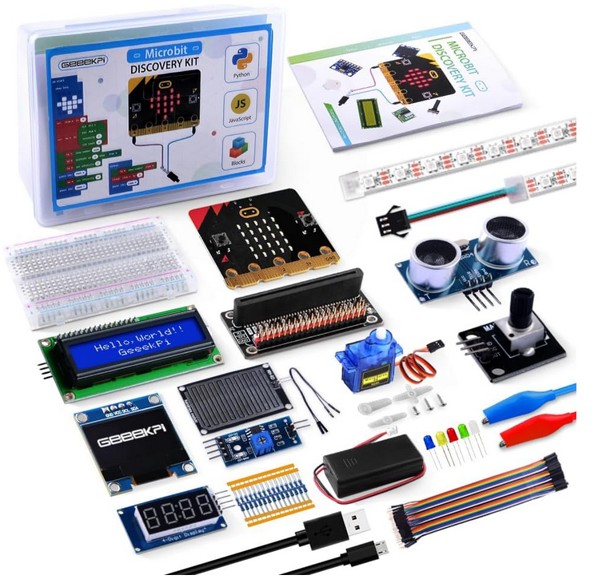
If you are a KS4 or KS5 student, explore the world of control engineering, coding and electronics with the GeeekPi Basic Starter Kit for the Microbit. This comprehensive set is perfect for beginners and can grow as your abilities develop. The kit offers a variety of components, sensors and modules to enhance the Microbit experience with greater interaction in the real-world. With everything you need to build your own project creations, you can bring your ideas to life with ease.
Want to win this kit? See below and tell us about an exciting project you’d love to bring to life using it!
The Microbit V2 is a pocket-sized programmable computer or, more correctly, a microcontroller. It has around 20 inputs and outputs, such as sound from its on-board speaker, 25 LEDs, 2 push-buttons, a motion sensor, light sensor, microphone, compass, radio and Bluetooth wireless. These features make it easy for you to get started with more fun projects. The Microbit can be programmed in Makecode blocks, JavaScript or Python.
The kit includes 7 frequently used modules along with a selection of components (LEDs, resistors etc) and development boards that allow easy connection of parts without soldering.
Specifically, the kit contains:
- 1 x BBC MicroBit Dev Board
- 1 x 400-hole breadboard
- 1 x 0.96-inch OLED display
- 1 x LCD1602 display
- 1 x 9g servo motor
- 1 x potentiometer on breakout board
- 1 x raindrops sensor on breakout board
- 1 x ultrasonic sensor on breakout board
- 1 x MicroBit extension board
- 1 x USB cable
- 1 x jumper wire ribbon
- 4 x circuit alligator glips
- 1 x pack of LEDs
- 1 x pack of resistors
- 1 x LED strip
A tutorial booklet is included with the kit that provides details of 9 demonstration projects using the parts in the kit.
The kit is supplied in its own storage case.
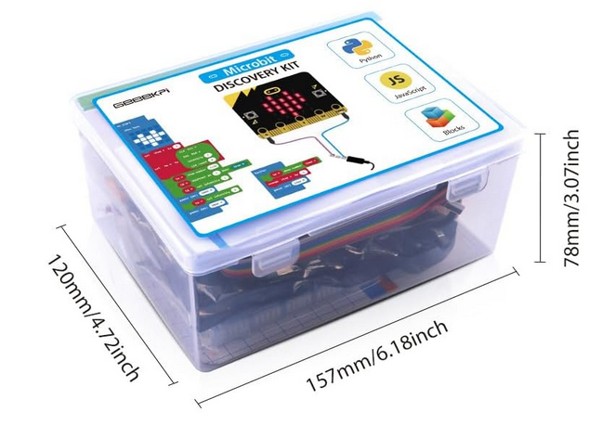
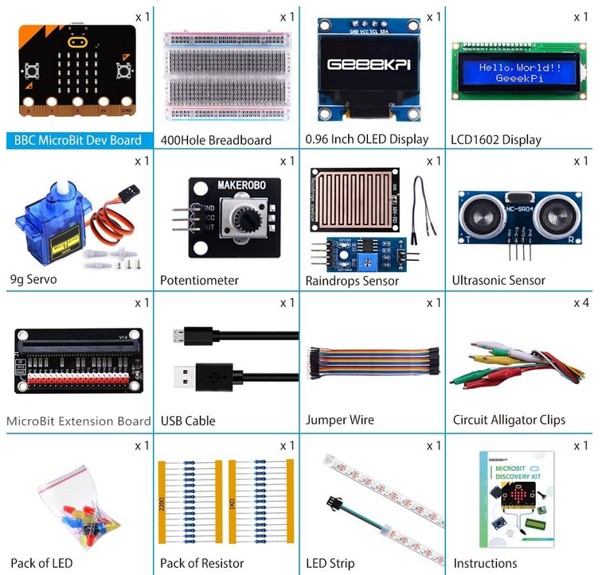
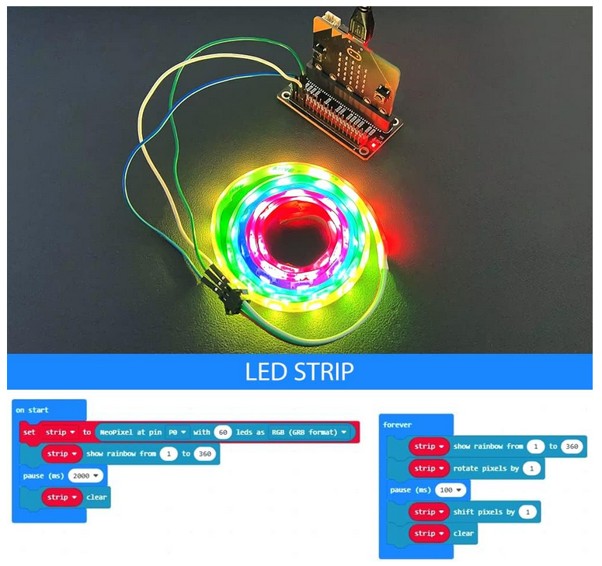
The above shows the full contents of the kit. With its tutorial and project examples you will lean to use and control some commonly used components via program control. For example, controlling a strip of multi-coloured LEDs with simple coding.
More information can be found at https://www.amazon.com/GeeekPi-Basic-Starter-Kit-Micro/dp/B0BKG9L5GY.
How to Enter
If you would like the opportunity to win this kit, we want you to write about 250 words (not more than 300) on an exciting project you would like to undertake with this kit. Up to 3 images or pictures of your own creation can be included to support your proposal.
Entry Requirements and Submission
The competition is open to all secondary-aged school students living or educated in Essex.
Entries should be submitted as either a Word Document or PDF file by email to
Your entry should include your email address, name, age and school.
The closing date for entries is 17:00 on Friday 18 December 2026.
Judging Criteria
The entries will be reviewed by members of CSES who will select a winner.
Entries will be judged on:
- Innovation
- Originality
- Creativity
- Engineering tactics
- Information content
- Effective communications
The winner will be notified by 31 January 2027.
Full terms and conditions of the competition are shown below.
Competition Terms and Conditions
- The competition is open to any Key Stage 4 or Key Stage 5 aged student living or being taught (in school or at home) in Essex, including the unitary authorities.
- The submission should be between a minimum of 200 words and a maximum of 300 words in length.
- The word count should be included in the submission.
- Submissions with a word count outside these limits will not be considered.
- In total, up to three drawings, images or other info-graphics of your own creation can be included to support your application.
- Submissions must be emailed as described above and be a single file in either Word or PDF format. The email should include student name, age and school.
- Entries received after the competition closes will not be considered.
- The writing must be the student's own and must not be previously published or entered into another competition. AI-generated entries will be rejected.
- Copyright for the submitted material remains with their authors. However, by entering the competition, participants grant CSES a nonexclusive, perpetual licence to use the submitted material for any legitimate purpose, including promoting the Society.
- If photos are included that contain people, the entrant is responsible for gaining their consent and (if necessary) securing use of their image free of copyright, fee or any other restriction. If your image contains the picture of anyone aged under 18 then you must submit an image consent form signed by their legal guardian.
- Entries will not be accepted into the competition if they are deemed inappropriate. This includes writing and any images that are offensive, previously published, copyrighted or deemed not to be in accordance with the spirit of the competition.
- There is only one prize.
- The prize will only be awarded subject to receiving a sufficient number of submissions at an appropriate standard of quality.
- CSES reserves the right to cancel the competition or alter the rules at any stage if circumstances arise outside of its control.
- There is no entry fee and no purchase necessary to enter this competition.
- Our decision in respect of all matters to do with the competition will be final. This includes any judging decisions.
- The winner will be notified by email. First name only will be published on the CSES website along with the submitted entry. If you do not wish for the name to be publicised, please tell us.
- The winner will be invited to attend the Chelmsford Science and Engineering Society (CSES) annual competition (TEXPO) held each year at the end of June, to showcase the use they have made of the kit, with the opportunity of winning further prizes.
If you have any queries, please contact